AML/CTF compliance platform for Australian Tranche 2 entities
Free program builder, risk assessment, CDD and registers for accountants, lawyers, conveyancers, real estate agents, TCSPs and precious-metals dealers who must be compliant under AUSTRAC Tranche 2 by 1 July 2026.
Note: Pricing and features for other vendors below are sourced from each vendor's public website and checked on the "last updated" date. Confirm current plans directly with the vendor before buying. This is general guidance, not legal advice.
Last updated: 3 July 2026 · Written against AUSTRAC's published Tranche 2 guidance and the AML/CTF Act 2006 (Cth)
- ✓ Free core toolkit — no card required
- ✓ Mapped to AUSTRAC's 6 minimum program components
- ✓ Records retained for the AUSTRAC-required 7 years
- ✓ No vendor lock-in — export your data anytime
AML/CTF Tranche 2 obligations commenced 1 July 2026. AUSTRAC enrolment for newly regulated accountants, lawyers, conveyancers, real estate agents and similar professions closes 29 July 2026. If you haven't picked a way to build and run your program yet, here's what's actually on the market — compared on price and features.
Are you a reporting entity?
AML/CTF obligations are triggered by providing a specific "designated service" listed in Schedule 1 of the AML/CTF Act — not by your industry alone. These are the Tranche 2 sectors and the services that typically trigger obligations:
| Sector | Typical designated service |
|---|---|
| Real estate professionals | Facilitating the sale or purchase of real property (agents, buyer's agents, some developers) |
| Lawyers and conveyancers | Managing client money, property or businesses; acting on the sale/purchase/transfer of real property or business assets |
| Accountants and bookkeepers | Managing client money or assets; acting as a formation agent; certain trust and company services provided alongside accounting |
| Trust and company service providers | Forming companies, acting as company secretary, providing a registered office, arranging for a person to act as a director, trustee or nominee shareholder |
| Dealers in precious metals, stones and products | Buying or selling precious metals, stones or products above the AUSTRAC-set threshold |
| Virtual asset service providers | Exchanging, transferring or safekeeping virtual assets on behalf of a customer |
| Financial advisers | Certain financial product advice and arrangement services captured under Schedule 1 |
Not exhaustive — read the full AUSTRAC Tranche 2 guidance or the Act itself to confirm whether a specific service you provide is captured.
Sector paths
Each profession page covers the obligations, deadlines and designated services specific to that sector:
Motor dealers and general high-value-goods dealers aren't yet a dedicated sector page on this site — see the follow-up report for that gap.
What is an AML/CTF compliance platform?
An AML/CTF compliance platform — often just called an AML platform or AML compliance software — is software that helps a reporting entity build, run and evidence its anti-money laundering and counter-terrorism financing program, instead of assembling it from scratch across Word documents, spreadsheets and AUSTRAC PDFs. It typically covers risk assessment, customer due diligence, governance and training registers, and reporting decisions — the components AUSTRAC expects every program to address.
The market roughly splits into two groups: heavier platforms built for banks, remitters and casinos under Tranche 1, with automated transaction monitoring and enterprise-scale pricing; and lighter platforms built specifically for Tranche 2 professional services businesses, sized for a proportionate, documented manual process. Picking the wrong category is a common — and expensive — mistake.
Not sure you need software at all yet? Start with the AML compliance software buyer's guide — what software can and can't do for a Tranche 2 firm, realistic costs, and the minimum stack by firm size. Or see the quick-reference provider shortlist for a condensed version of this table.
AML/CTF compliance platforms compared
Ordered roughly cheapest to most expensive (or least to most disclosed, where a vendor doesn't publish pricing):
AML Compliance Guide
This platform- Built for
- Tranche 2 professionals — accountants, lawyers, conveyancers, real estate agents and similar
- Pricing
- Free core toolkit (program builder, risk assessment, registers) with a free account
- Notable strength
- Program builder mapped to AUSTRAC's 6 minimum components, live customer risk scoring, and governance, training and SMR registers in one place
- Watch out for
- No automated transaction monitoring — by design, since AUSTRAC does not require it for a proportionate Tranche 2 program
- Built for
- Real estate and property professionals specifically
- Pricing
- From $59/month
- Notable strength
- Built narrowly for the property sector rather than professional services generally
- Watch out for
- Not built for accountants, lawyers or conveyancers working outside property transactions
- Built for
- 6 Tranche 2 categories, aimed at businesses under 20 staff
- Pricing
- $73.37/month (incl. GST), no lock-in contract
- Notable strength
- Fixed low monthly fee, with EDD workflow and beneficial ownership tracing included
- Watch out for
- Identity verification checks are billed separately at $4 each on top of the monthly fee
- Built for
- Accountants, lawyers, conveyancers and real estate agents
- Pricing
- $8 per identity + screening check (usage-based)
- Notable strength
- AML/CTF Program Generator plus automated KYB for trusts and SMSFs
- Watch out for
- No flat published subscription — cost scales with how many checks you run
- Built for
- Real estate, conveyancers, legal practitioners and accountants
- Pricing
- Advertised free until 1 July 2026 — that date has now passed, so confirm current pricing
- Notable strength
- Risk assessment and staff training were bundled into its free introductory period
- Watch out for
- Ongoing pricing after the promotional period isn't published — check their calculator before committing
- Built for
- Real estate agents, conveyancers, auctioneers and lawyers who hold client funds in trust
- Pricing
- $1,200–$2,400/year depending on user and ID-check limits
- Notable strength
- Bundles AML/CTF with trust accounting and integrates with Xero, MYOB and QuickBooks
- Watch out for
- AML/CTF plans are priced separately from, and in addition to, its trust accounting plans
- Built for
- All AUSTRAC reporting entities, not just Tranche 2
- Pricing
- From around $350/month
- Notable strength
- Automated SMR/TTR/IFTI/ACR reporting, transaction monitoring and AI document verification
- Watch out for
- Built for the full range of reporting entities — more automation and cost than most Tranche 2 practices need
- Built for
- Legal, accounting, conveyancing, real estate and precious metals sectors
- Pricing
- Not published — request a quote
- Notable strength
- Dedicated customer-facing portal for CDD intake, kept separate from the internal review workspace
- Watch out for
- No public pricing to compare against other options up front
AUSTRAC obligation → platform feature
What each core Tranche 2 obligation actually requires, and the specific free-toolkit feature that covers it:
What to look for, whichever you pick
Check any platform above — or any other one you're evaluating — against these before you commit:
Maps to AUSTRAC's minimum program components
Direct coverage of the 6 components AUSTRAC requires — governance, risk assessment, ongoing CDD, third-party reliance, personnel due diligence and training, and independent evaluation — not a generic global AML checklist.
AUSTRAC guidanceProportionate to your risk profile
Tranche 2 businesses aren't required to run automated transaction-monitoring software. A platform built for this sector should support a documented, consistently applied manual process instead.
AUSTRAC guidanceA real CDD workflow
Can it run and record initial CDD, apply enhanced due diligence for higher-risk customers, and prompt a review when a customer's risk profile changes?
AUSTRAC guidanceGovernance and personnel registers
Compliance officer appointment and eligibility, staff due diligence, and training completion — the records AUSTRAC expects a business to produce on request.
Documented reporting decisions
A program needs to show the reasoning behind suspicious matter reporting decisions, including cases where a report was considered but not filed.
Independent evaluation readiness
AUSTRAC requires an independent evaluation at least once every 3 years. Records need to be exportable or reviewable by someone outside your compliance function.
Built for your tier, not a different one
Software built for banks, remitters and casinos (Tranche 1) is a different product to one built for newly regulated professions (Tranche 2).
Transparent, checkable pricing
Some platforms publish a flat monthly fee, others charge per identity check, others don't publish pricing at all. Get the real number before you compare features.
What AML Compliance Guide actually looks like
Not mockups — these are live screens from the free toolkit, no account required to try them.
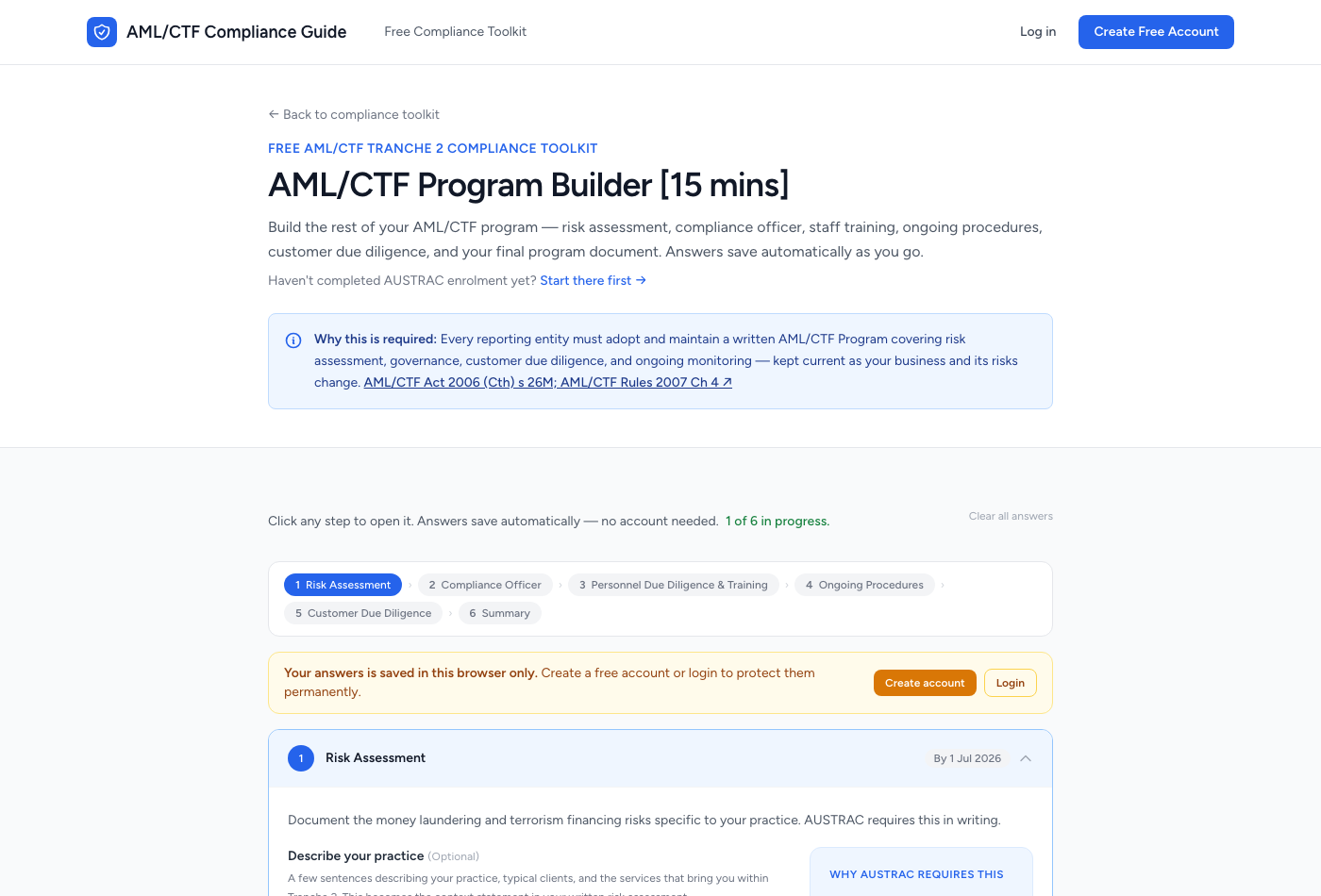
Program builder tracks progress across all 6 AUSTRAC minimum components and autosaves in the browser as you go — you can start answering before creating an account, then save your plan permanently when you're ready.
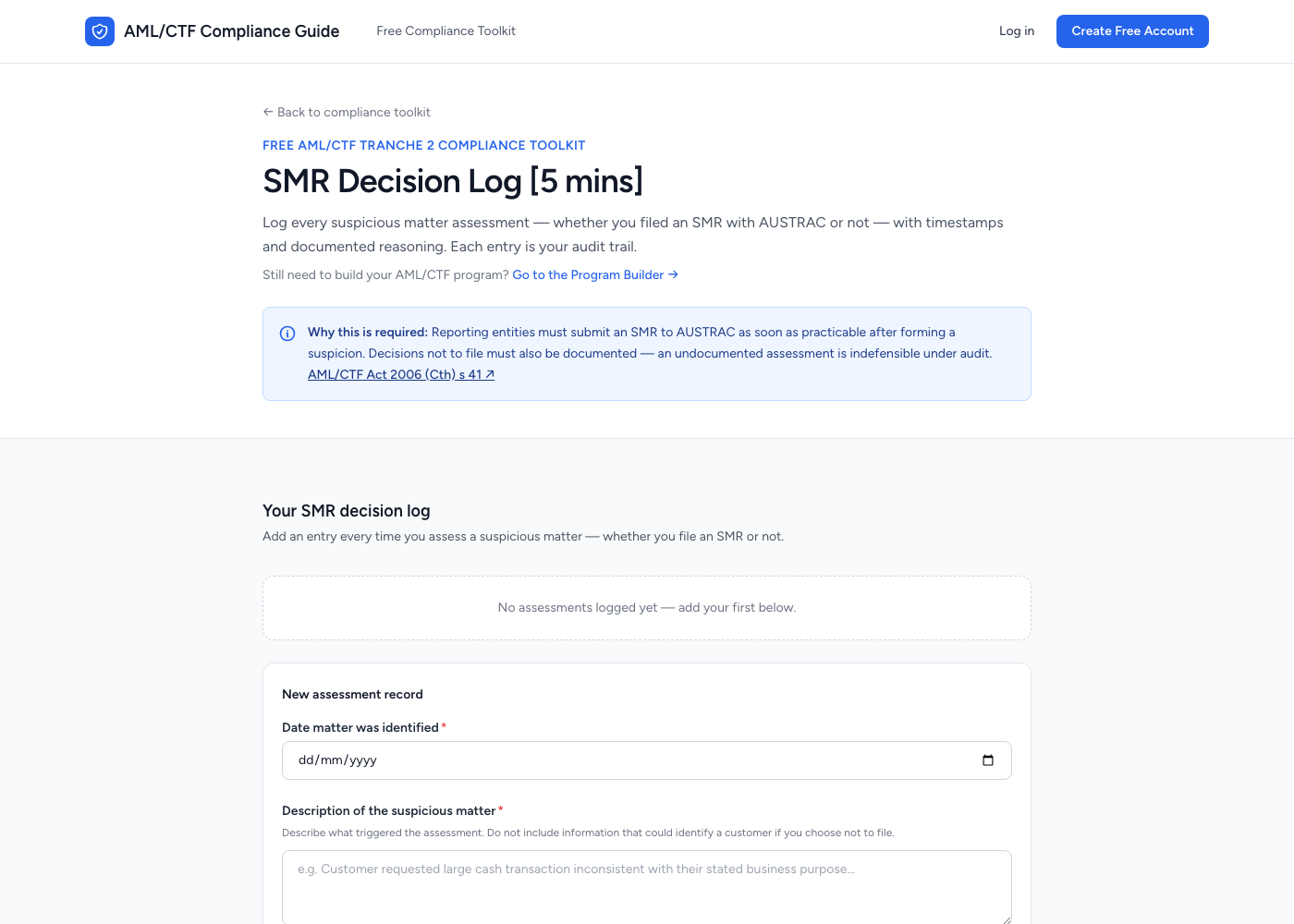
SMR decision log — every assessment gets a timestamped entry, whether or not you end up filing. This is what makes a "we considered it and decided not to report" decision defensible under audit, instead of just a memory.
Pricing
One real, public tier — see the comparison table above for how competitors' pricing (where published) stacks up.
Free
Program builder, risk assessment, compliance officer / staff due diligence / training / SMR registers, enrolment preparation, guidance library — all included with a free account. No card required, no seat limits published.
Identity verification within the CDD tool is a paid, per-check step (pricing shown at the point of use) — everything else on this list is free.
Everything in the free toolkit
AML/CTF program builder
Answers a short set of questions about your business and produces a 7-step AML/CTF program plan covering all 6 AUSTRAC minimum components.
Customer due diligence
Runs and records CDD checks against your customers so you can show AUSTRAC how identity was verified.
Compliance officer register
Records who has held the AML/CTF compliance officer role, eligibility assessments, and appointment dates.
Staff due diligence register
Tracks due diligence and suitability checks for personnel performing AML/CTF functions.
Training completion register
Records AML/CTF training completion dates by staff member and flags when retraining is due.
SMR decision log
Documents the reasoning behind suspicious matter reporting decisions, including cases where no report was filed.
Enrolment preparation
Walks through the information AUSTRAC Online asks for so enrolment is a copy-paste exercise rather than a guessing game.
AUSTRAC-GPT
An AI assistant trained on AUSTRAC guidance for quick, sourced answers to Tranche 2 questions.
Guidance library
Plain-English summaries of AUSTRAC program and risk assessment guidance, kept up to date as AUSTRAC publishes more.
Who it's for
Built for the professions newly covered by AML/CTF Tranche 2, including:
How it works
Answer questions about your business
The program builder asks about your services, customers and delivery channels to work out which obligations apply to you.
Get your 7-step program plan
A draft AML/CTF program mapped to the 6 AUSTRAC minimum components, ready to refine and approve.
Run risk assessments and CDD checks
Rate customer risk and record due diligence as you onboard, using the same account.
Keep your registers current
Compliance officer, staff due diligence, training and SMR decision registers stay in one place, ready for an audit or independent evaluation.
Frequently asked questions
Do I need to enrol with AUSTRAC?
If your business provides a "designated service" listed in Schedule 1 of the AML/CTF Act — for example, certain legal, conveyancing, accounting, real estate, trust and company, or precious metals/stones services — you must enrol with AUSTRAC before providing that service. Enrolment for newly regulated Tranche 2 entities closes 29 July 2026. See the <a href="#reporting-entity" class="text-blue-600 hover:underline">designated services table above</a> to check your sector.
What is a "designated service"?
A designated service is a specific service listed in Schedule 1 of the AML/CTF Act 2006 (Cth) — not every service your business provides. For a lawyer, it might be managing client money in a transaction; for a real estate agent, it's facilitating the sale or purchase of real property. Providing a designated service is what triggers AML/CTF obligations, not your job title or industry alone.
What's the difference between Part A and Part B of an AML/CTF program?
Under the amended program framework, Part A is the risk-based core of your program — your ML/TF risk assessment and the policies, procedures and controls that respond to it (governance, CDD, training, independent evaluation). Part B covers the customer identification procedures used to verify who your customers are. Existing reporting entities had to move to this Part A/Part B structure by 31 March 2026; new Tranche 2 entities build to it from the start. See our <a href="/aml-ctf-program-requirements" class="text-blue-600 hover:underline">program requirements guide</a> for the full breakdown.
When do Tranche 2 obligations start?
AML/CTF Tranche 2 obligations commenced on 1 July 2026. AUSTRAC enrolment for newly regulated entities — accountants, lawyers, conveyancers, real estate agents, TCSPs, and dealers in precious metals and stones — closes 29 July 2026.
Who is my AML/CTF Compliance Officer, and who's eligible?
Your compliance officer must be at management level, ordinarily resident in Australia (if you operate through a permanent establishment here), and a fit and proper person — they don't need to be an employee or hold direct reports, but they do need real authority over the program. You must appoint one within 28 days of providing a designated service and notify AUSTRAC within 14 days of appointment. See our <a href="/compliance-officer-requirements" class="text-blue-600 hover:underline">compliance officer requirements guide</a>.
Do accountants need to lodge suspicious matter reports (SMRs)?
Yes — any reporting entity, including accountants providing a designated service, must submit an SMR to AUSTRAC as soon as practicable after forming a reasonable suspicion, regardless of whether a transaction proceeds. Decisions not to file also need to be documented and reasoned; an undocumented "we considered it and decided not to report" is hard to defend under audit.
What triggers enhanced customer due diligence (ECDD)?
Common triggers include a customer or transaction being assessed as high ML/TF risk, a politically exposed person (PEP), instructions inconsistent with the customer's known profile or stated purpose, unusual transaction patterns, adverse media, or a connection to a high-risk jurisdiction. Your program needs to document what ECDD measures apply — extra identity evidence, senior sign-off, more frequent review — and when they're triggered.
How is source of funds verified for a Tranche 2 transaction?
There's no single prescribed method — AUSTRAC expects a risk-based approach. For lower-risk customers this might be a client's own statement of the funds' origin corroborated by supporting documents (payslips, sale contracts, loan approvals); for higher-risk customers you'd expect independent verification such as bank statements tracing the funds, or a solicitor's letter. The higher the risk rating, the more corroboration is expected.
Do Tranche 2 businesses need automated transaction-monitoring software?
No. AUSTRAC's guidance for Tranche 2 entities accepts a proportionate manual process — for example, reviewing client instructions against their known profile — provided it is consistently applied and documented. Platforms like OverSEER AML that build in automated transaction monitoring are aimed more at Tranche 1 entities (banks, remitters, casinos) than a typical accounting or conveyancing practice.
Is a free platform enough for Tranche 2 compliance?
For a straightforward, proportionate program, a free toolkit that maps to AUSTRAC's minimum components can be enough to get a working program in place. More complex or higher-risk businesses may still need tailored advice from a consultant or lawyer, or a paid platform with built-in identity verification at scale.
Is an "AML platform" the same as an "AML/CTF compliance platform"?
Yes — "AML platform," "AML/CTF compliance platform," "AML software" and "AML compliance software" all refer to the same category of tool: software that helps a reporting entity build, run and evidence its anti-money laundering and counter-terrorism financing program. AUSTRAC's own guidance uses "AML/CTF program," which is why Australian vendors and this page use the fuller "AML/CTF compliance platform" term, but "AML platform" is the shorter, more common way people search for the same thing.
What are the best AML/CTF compliance platforms for Tranche 2 businesses in Australia?
There's no single "best" platform — it depends on your sector and budget. AMLTranche and Flagship AML are the cheapest fixed-fee options (from $59–$73/month), ClearAML and TrustSoft bundle in identity/KYB checks or trust accounting, OverSEER AML is built for the full range of reporting entities including banks and remitters (and priced accordingly, from around $350/month), and AML Compliance Guide's core toolkit — program builder, risk assessment and registers — is free.
How does AML Compliance Guide compare to paid platforms like ClearAML or Flagship AML?
Paid platforms typically bundle identity verification and sanctions screening into their pricing, charged either as a flat monthly fee (Flagship AML, TrustSoft) or per check (ClearAML). AML Compliance Guide focuses on the program, risk assessment and register side of Tranche 2 compliance — the parts every reporting entity needs regardless of transaction volume — and keeps that free, with a paid identity verification step inside the CDD tool.
A lightweight AML platform, built exclusively for Tranche 2
Get AUSTRAC's mandates done as fast and effortless as possible.
- Built around AUSTRAC's actual requirements
- Single maintained compliance file
- No compliance expertise required
- 25 minute initial compliance setup
- Obligations calendar & reminders
- Instant data export
Not sure you're covered yet?
Check the AML/CTF program requirements to see what a compliant program must contain.
View program requirements →Written from AUSTRAC's published Tranche 2 guidance and each vendor's public website. Not legal advice — complex or high-risk businesses should seek professional advice for their specific situation.